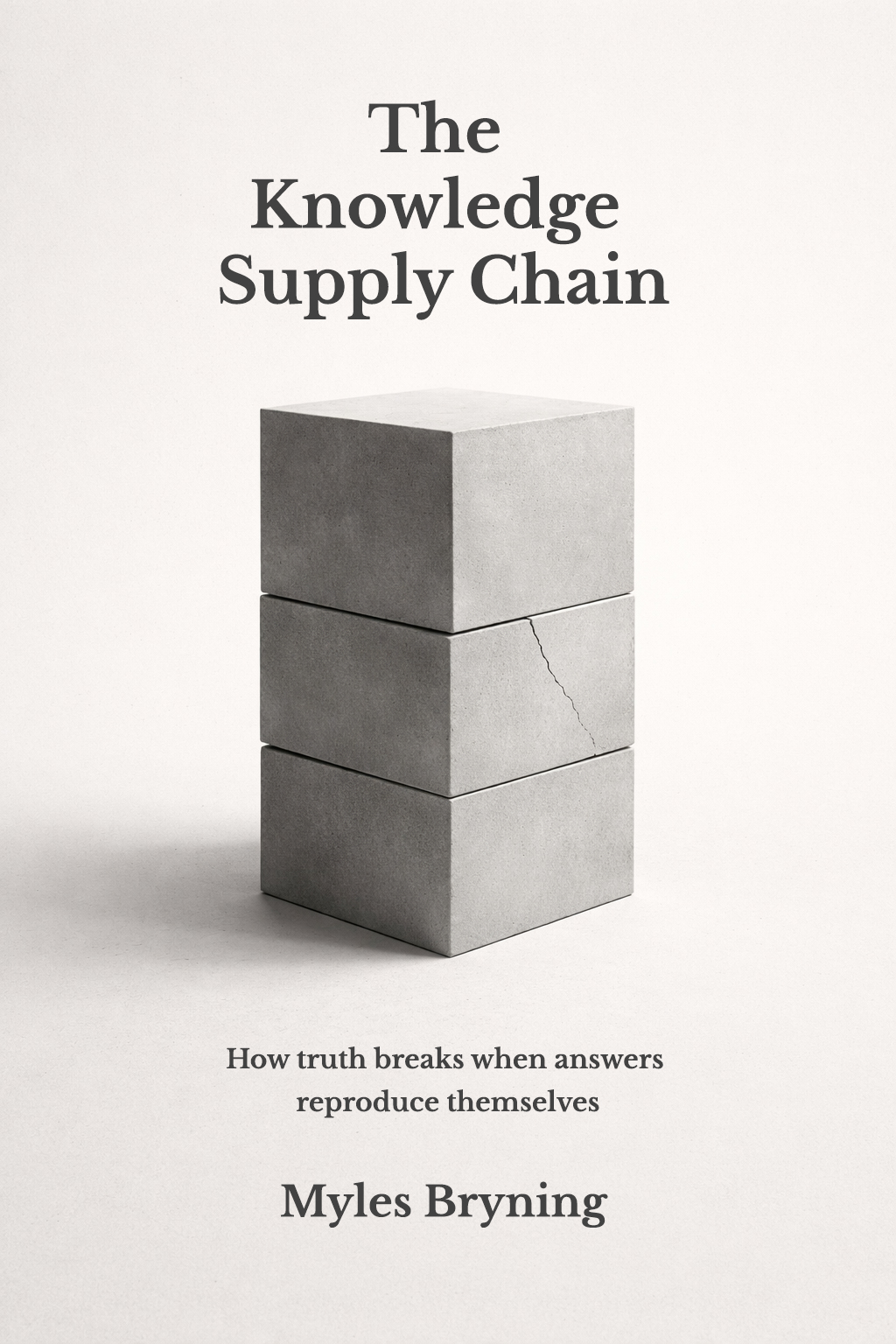
The Knowledge Supply Chain
How answers move, degrade, and fail as they are reused at scale.
The Knowledge Supply Chain examines what happens to answers after they leave the room where they were made.
It follows how knowledge is summarised, copied, automated, embedded, and reused across organisations and systems. At each step, context is stripped away, assumptions are softened, and uncertainty is lost.
What remains travels faster and feels more certain, even as it becomes less reliable.
What this book examines
- How reuse changes the meaning of an answer
- Why automation amplifies confidence but not judgement
- How exceptions signal fragility long before failure
- Why scale turns small misalignments into systemic problems
Central argument
Most modern knowledge failures are not individual mistakes. They are supply-chain failures.
Answers degrade quietly as they move through systems. Each hand-off removes context while preserving authority. By the time something breaks, the origin of the decision is too far upstream to revisit easily.
This book treats knowledge like infrastructure: something that must be designed, maintained, and monitored over time.
Who this book is for
This book is for people working inside complex systems:
- organisations operating at scale
- teams relying on dashboards, workflows, and automation
- anyone responsible for outcomes they did not directly decide
What the reader gains
The ability to see where fragility enters long before a failure occurs. The book offers a way to identify weak points in how knowledge is produced, transferred, and reused, before consequences become unavoidable.