Canonical Map
CueCrux canonical map: core objects, operational flow, and governance state machine.
Abstract: This page defines CueCrux as a system of proof-carrying answers: the objects the system produces, the operational flow that makes outputs verifiable, and the governance state machine that keeps reuse safe over time.
Core objects
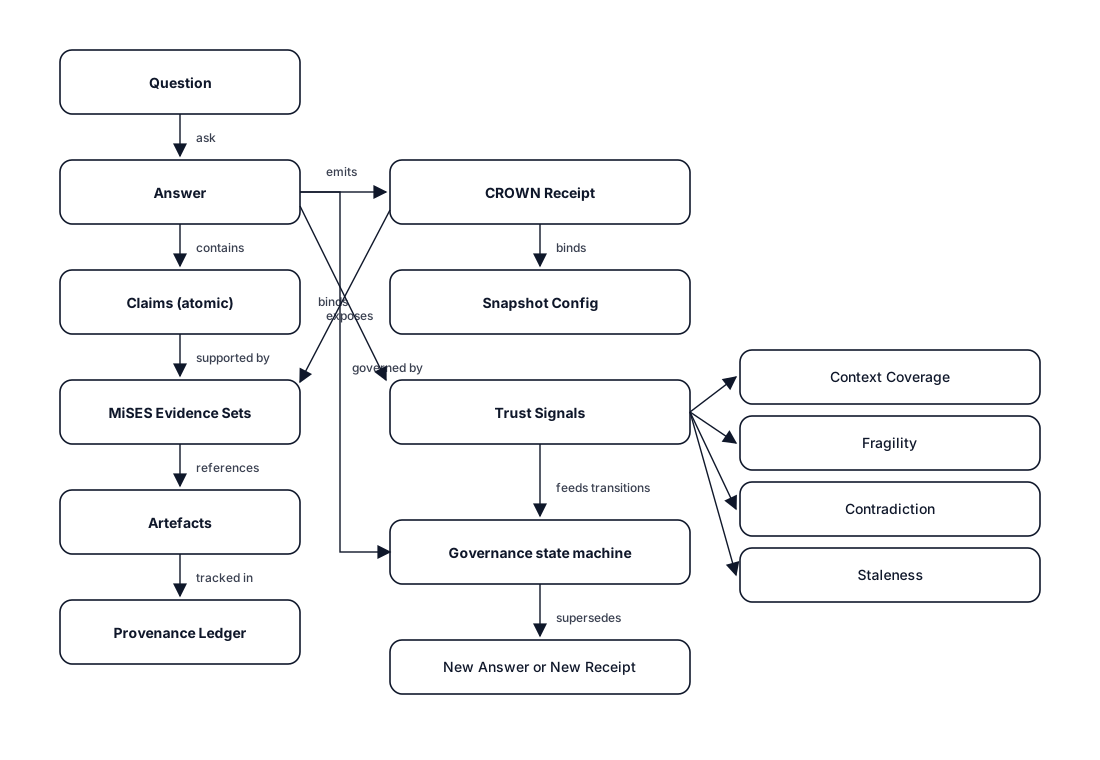
Claim: answers are objects made of claims, evidence, and receipts. If you drop receipts, you have not integrated trust, you have integrated hope.
Show draft diagram source
A -->|emits| RCCROWN Receipt RC -->|binds| MIS RC -->|binds| CFGSnapshot Config
A -->|exposes| TSTrust Signals TS --> COVContext Coverage TS --> FRFragility TS --> CONTRAContradiction TS --> STALEStaleness
A -->|governed by| GOVGovernance state machine TS -->|feeds transitions| GOV GOV -->|supersedes| A2New Answer or New Receipt
Operational flow
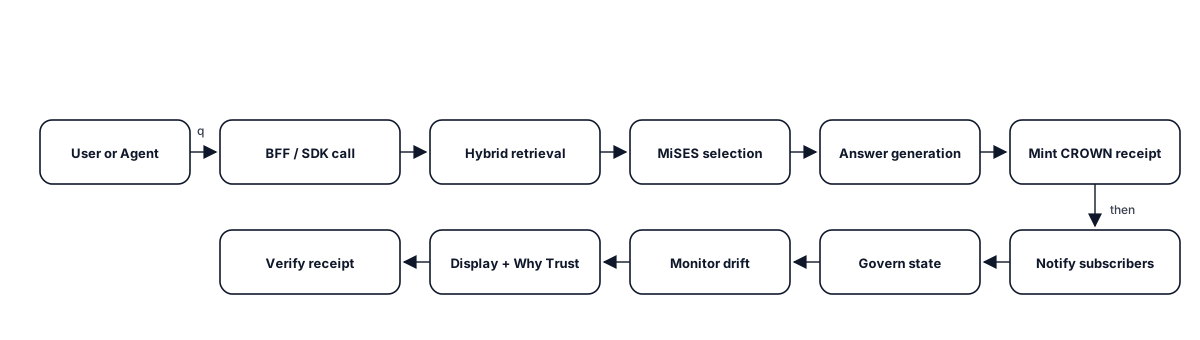
Claim: verified answers are built from retrieval to MiSES to receipts, then verified, displayed, monitored, and governed. If any step is skipped, risk leaks into the plumbing.
Show draft diagram source
Governance state machine
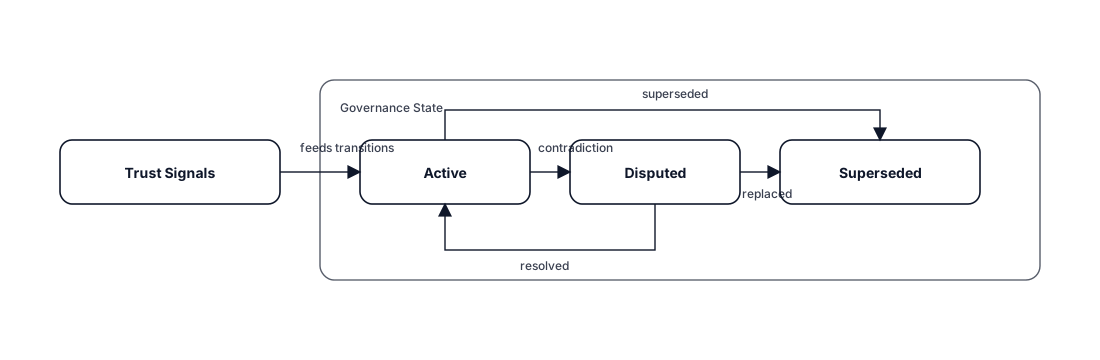
Claim: governance is procedural. Trust signals trigger transitions, and supersedence is explicit rather than accidental.
Show draft diagram source
subgraph GOV_STATES"Governance State" direction LR ACTActive DISDisputed SUPSuperseded end
J1 --> ACT ACT -->|contradiction emerges| DIS DIS -->|resolved| ACT ACT -->|superseded| SUP DIS -->|replaced| SUP
Glossary
| Term | Meaning | What to remember |
|---|---|---|
| Answer | A proof-carrying object, not just text | Store IDs and receipts, not screenshots |
| Claim | An atomic statement inside an answer | Claims can be supported, contradicted, or marked insufficient |
| MiSES | Minimal Sufficient Evidence Set | Smallest non-redundant support set, not citation dumping |
| Artefact | Evidence unit: document, chunk, extract | Has provenance, licence, timestamps, hashes |
| Receipt (CROWN) | Signed snapshot binding answer to evidence and config | If you cannot verify it, do not call it verified |
| Snapshot | The recorded retrieval and model configuration | Enables replay and drift detection |
| Coverage | How much of the relevant evidence space was touched | Stops thin answers sounding complete |
| Fragility | Sensitivity to removing key evidence | Turns unease into a defensible signal |
| Contradiction | Dissenting evidence found in the same window | Treat as data, not a UI nuisance |
| Governance state | Active, disputed, superseded | Answers can change without becoming political |
Integration contract
What an integrator must store
Store these fields with any answer that influences a workflow:
- answer_id
- receipt_id
- mode (light, verified, audit)
- as_of and time_window (explicit or inferred)
- coverage label and fragility score (or at least high or low)
- contradiction status (present or not)
- governance state (active, disputed, superseded)
If you only store the text, you are keeping the vibe and binning the warranty.
What an integrator must verify
- Verify receipt signature server-side (hash plus signature).
- Reject verified UX if verification fails.
- Treat superseded or disputed answers as escalations, not autopilot inputs.